

A Complete, Practical Guide for Owners of Overweight Cats
If your cat is overweight, you are not alone. In the UK, nearly half of domestic cats are above their ideal weight. This is not a moral failure. It is a predictable consequence of modern indoor living colliding with feline biology.
Cats evolved to hunt small prey multiple times a day. Movement was mandatory. Food was earned. Today, food is constant, movement is optional, and neutering lowers energy needs by up to 30 percent. The math changes. Most homes do not.
Step One: Remove Emotion From Measurement
Before changing anything, measure.
Weigh your cat.
Ask your vet to assess Body Condition Score (BCS).
Check whether ribs are easily felt and whether a waist is visible from above.
Many owners underestimate weight gain because it happens gradually. A gain of just 300–500 grams per year in a 4–5 kg cat is clinically significant.
You cannot manage what you do not measure.
Step Two: Stop Feeding on Instinct
Most overfeeding is not dramatic. It is subtle.
A slightly rounded scoop.
A few extra kibbles.
Two treats that feel harmless.
Ten extra pieces of dry food per day can translate into over a kilogram of weight gain across a year.
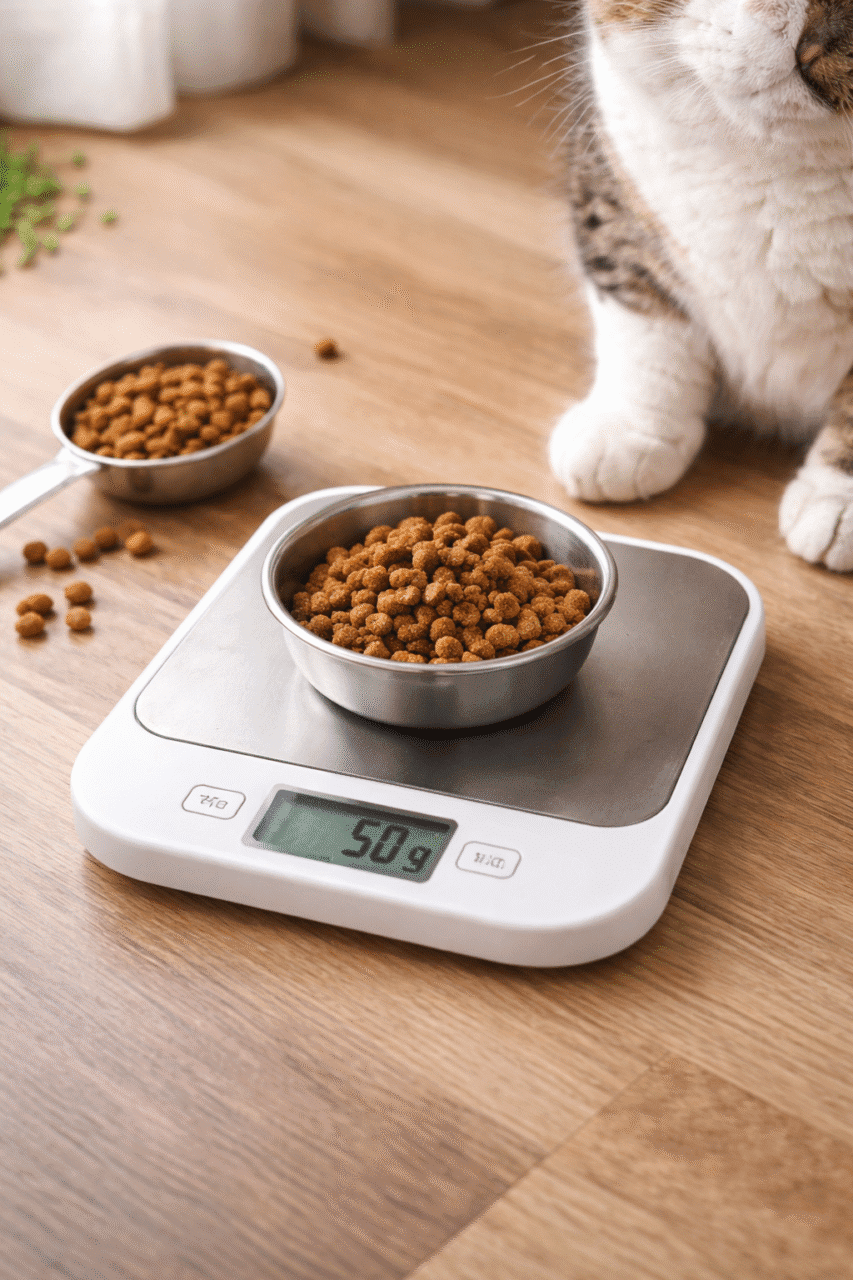
Use a kitchen scale.
Feed measured portions.
Remove constant grazing.
Structured meals restore metabolic rhythm.
Step Three: Understand the Hunger Illusion
Many owners say, “My cat is always hungry.”
Often, this is learned behaviour.
Cats quickly associate vocalising with food delivery. If meowing works, it continues. Behavioural reinforcement is powerful. Appetite and habit are not the same.
Before reducing calories, increase stimulation.
Play for 5–10 minutes before meals. Short, intense bursts that mimic prey movement are more effective than passive toys. Movement improves insulin sensitivity independently of weight loss.
Step Four: Reduce Gradually, Never Drastically
Cats cannot crash diet safely. Rapid restriction can trigger hepatic lipidosis, a potentially fatal liver condition.
Safe weight loss is approximately 0.5–2 percent of body weight per week.
If your cat weighs 6 kg, that means 30–120 grams weekly. Slow progress is correct progress.
Reduce calories by 5–10 percent at a time. Reassess monthly.
Step Five: Protect Muscle, Not Just Reduce Fat
High-protein diets help preserve lean body mass during weight reduction. Muscle is metabolically active tissue. The goal is not simply a lower number on the scale, but healthier body composition.
Encourage climbing, jumping, vertical spaces. Indoor cats need engineered environments that stimulate movement.
Step Six: Address the Emotional Layer
This is where most plans fail.
Feeding feels like care. Treats feel like affection. Refusing feels cold.
But excess adipose tissue increases inflammatory signalling, diabetes risk and joint degeneration. Lean cats have been shown to live up to two years longer.
The question is not whether you love your cat. It is whether your habits align with longevity.
Replace treats with rituals.
Evening grooming.
Interactive play.
Puzzle feeding.
Fixed routines.
Cats respond to predictability more than indulgence.
Step Seven: Monitor Like a Clinician
Weigh every four weeks.
Adjust only if progress stalls.
Think in months, not days.
Weight management is a slow physiological recalibration, not a dramatic transformation.
Surprising but Important Facts
Neutered cats need fewer calories but often feel equally hungry.
Dry food is energy dense and easy to overestimate.
Even a 5 percent reduction in body weight improves metabolic markers.
Most feline obesity develops quietly over years, not weeks.
The Real Mindset Shift
Your cat is not lazy.
You are not failing.
This is an environmental mismatch.
Correcting it requires structure, not punishment. Precision, not panic.
Measure.
Schedule.
Stimulate.
Adjust slowly.
Longevity is built in small, consistent decisions.